 Illegal,
unreported and unregulated (IUU) fishing has far-reaching
consequences for the long-term sustainable management of capture
fisheries. When IUU fishing goes unchecked, the system upon
which fisheries management decisions are based becomes flawed. Illegal,
unreported and unregulated (IUU) fishing has far-reaching
consequences for the long-term sustainable management of capture
fisheries. When IUU fishing goes unchecked, the system upon
which fisheries management decisions are based becomes flawed.
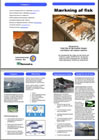
The proposed SPARTACUS project aims to
introduce (in pilot areas) tools of artificial technology
(robot system) in fish landing ports and aquaculture
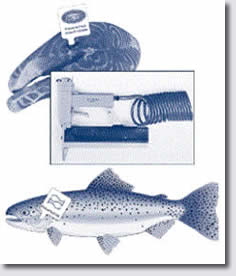
packaging units of fish. The robot will insert
special tags in a specific area of the
fish's head (operculum-gill cover) avoiding the injury of
the fish and blood extraction. The tag will contain all
the necessary information (and additional as an option)
in order to comply with the council regulation No 104/2000
of December 17 1999, that dictates that all fish products
may not be offered for retail sale to the final consumer,
unless appropriate marking or labelling indicates:
a) the commercial designation of the species
b) the production method (caught at sea or in inland waters
or farmed)
c) the catch area.
Since tags can be placed in principle on fish with a size
of more than 250 gr, smaller fish should be placed in boxes
and marked with special stickers that will comply with the
regulation 104/2000.
Although in all EU countries regulation and legislation
against IUU is in force categorised in a) measures to enhance
monitoring, control and surveillance and to penalize
non-compliance (b) measures affecting IUU fishing
markets and profitability (c) measures to enhance
flag State control and (d) other measures to combat
IUU fishing (see Appendix I on page 31), the vast
majority of the consumers are not aware of the fishing regulations
and therefore the pressure of the public opinion is not
active in the battle for the protection of the fish stocks
and against IUU fishing. Therefore SPARTACUS will focus
also in public awareness actions as one of the ways to combat
IUU fishing is considering pressure of the consumers at
the "market" stage of the fisheries industry chain.
The proposed SPARTACUS project aims to:
 1)
Develop and test a special artificial intelligence system
(robot system) that will have the ability to insert in a fast
and reproducible way specially designed tags in a special area
of the fish's head (operculum-gill cover). The tag will contain
various information (adjustable by the user) that will certify
that the specific fish originates from legal fishing methodology.
The advantages of such system include: 1)
Develop and test a special artificial intelligence system
(robot system) that will have the ability to insert in a fast
and reproducible way specially designed tags in a special area
of the fish's head (operculum-gill cover). The tag will contain
various information (adjustable by the user) that will certify
that the specific fish originates from legal fishing methodology.
The advantages of such system include:
- Easy recognition of the origin of the fish (legal or
illegal activity) by the consumers.
- Secure the production of the legally established fishermen
co-operatives.
- Facilitate the awareness of the public towards consumption
of legal products.
- Facilitate the traceability of the products.
2) Propose best practices and adaptation plans for the
fish landing ports and aquaculture packaging units that
will comply with the council regulation No 104/2000. Special
attention will be given that the introduction of the new
tools will not complicate the function of the fishing port
but will be user friendly and smoothly adopted in the daily
routine.
3) In parallel, actions to aware and inform the public
opinion for the consequences of IUU fishing and prompt them
to be proactive in their consuming preferences will be planned
and will take place in pilot areas.
Therefore the objectives of SPARTACUS can be summarised
as follows:
- Develop special artificial intelligence systems (robot
arms) for the insertion of the tags that will assist the
implementation of EU policies.
- Implement in a pilot scale, demonstration of the function
of the tagging mechanisms in fish landing ports of South
and North Europe as well as in aquaculture packaging units.
- Provide tools (through tagging) for public awareness
against IUU fishing.
- Design special campaigns and dissemination of material
for alerting consumers, fishermen and industry against
IUU fishing.
 |
 |
 |
|
 |
 |
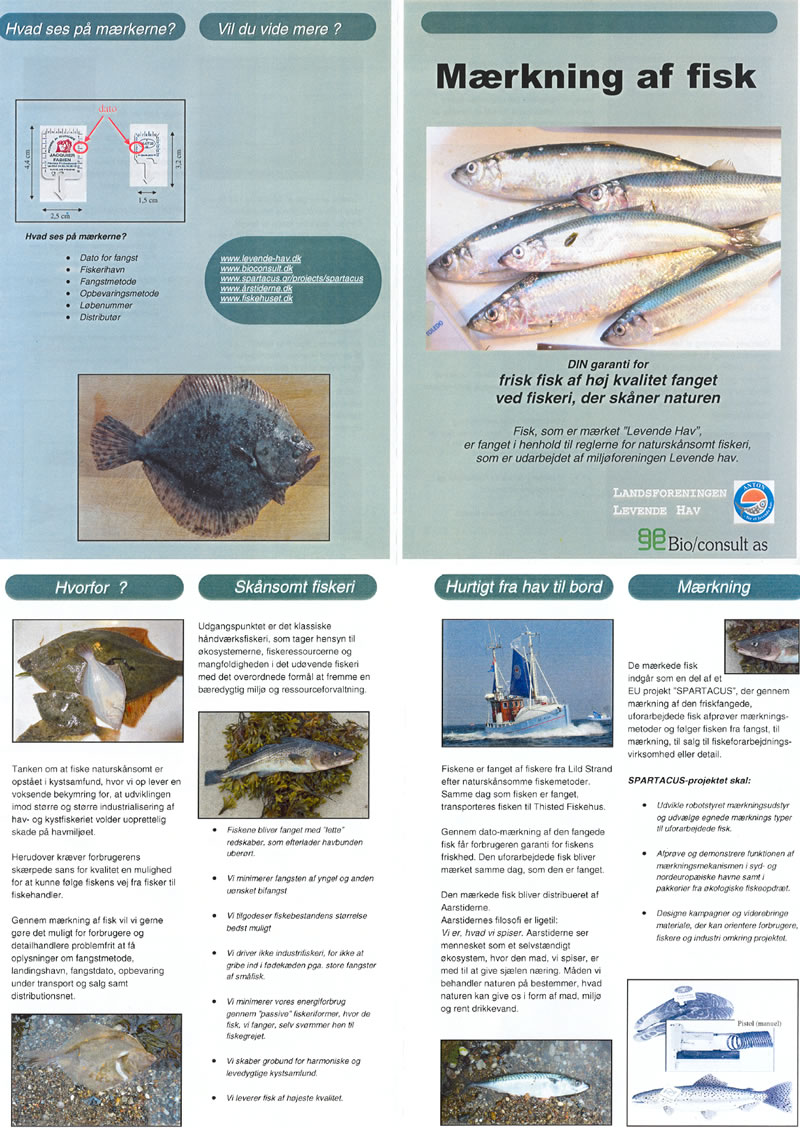
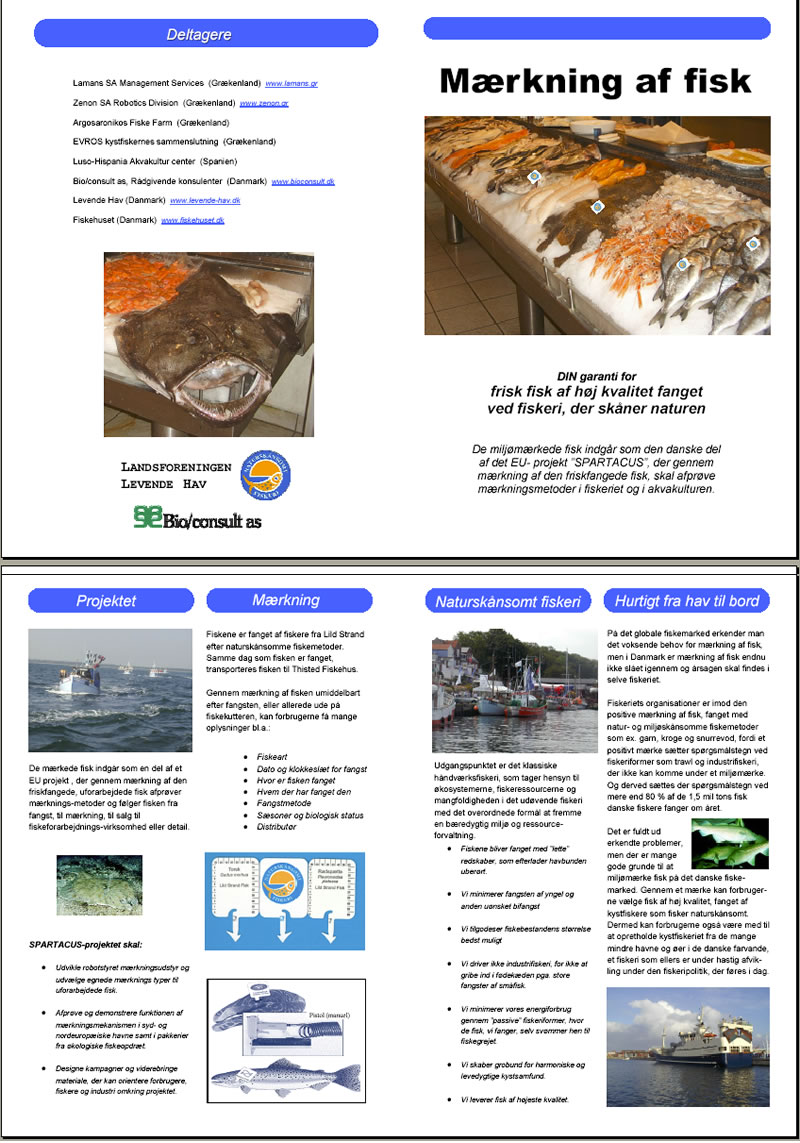
Danish Leaflet |
Danish Leaflet |
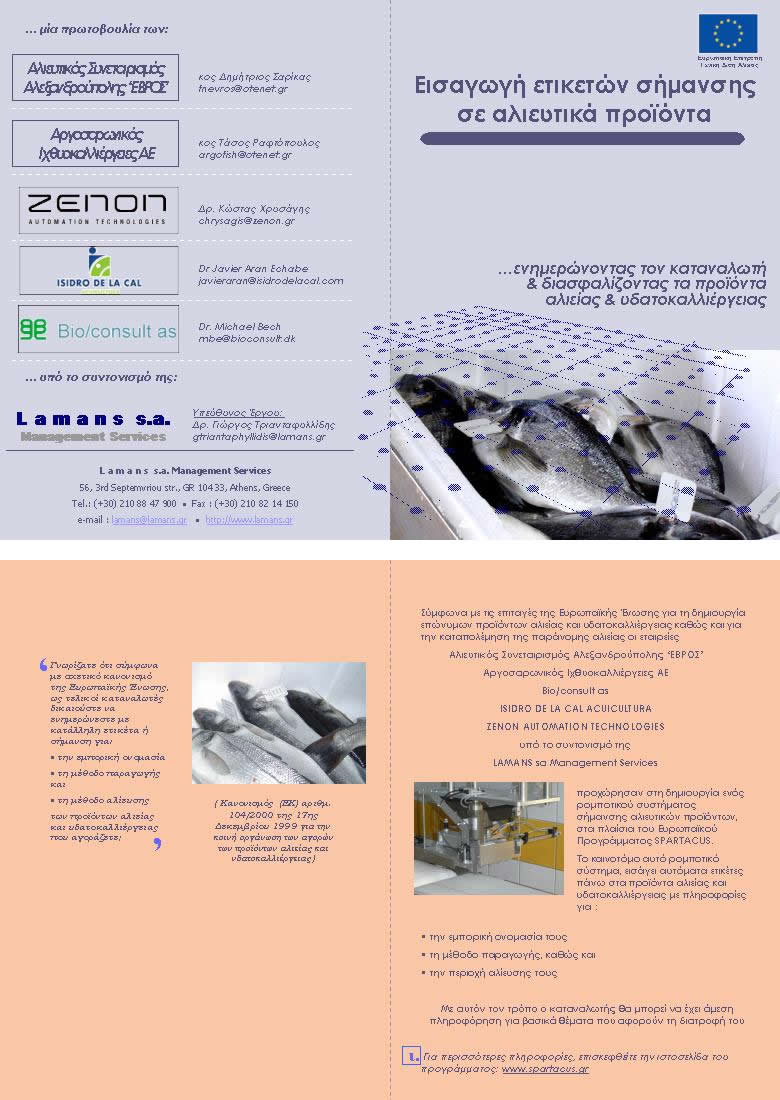
Greek Leaflet |
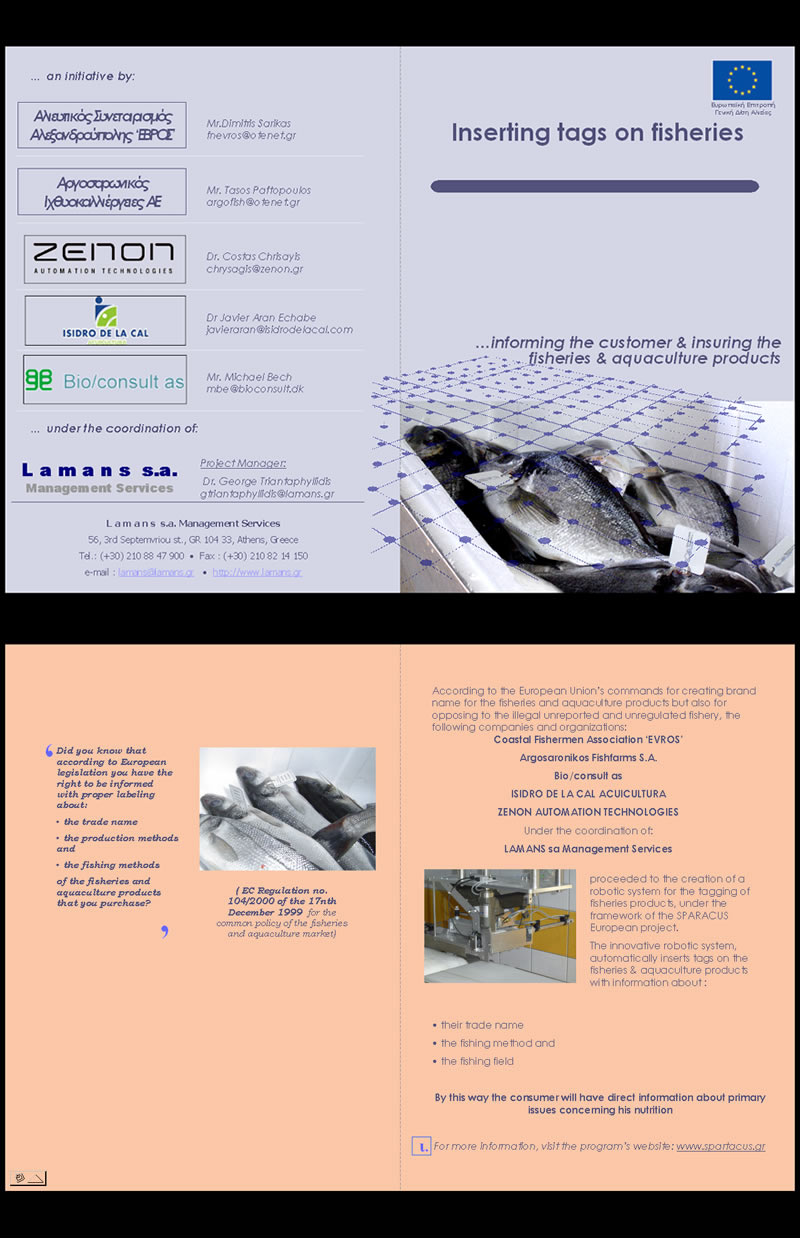
English Leaflet |
Greek Leaflet IUU |
TV/MIDT-VEST |
|